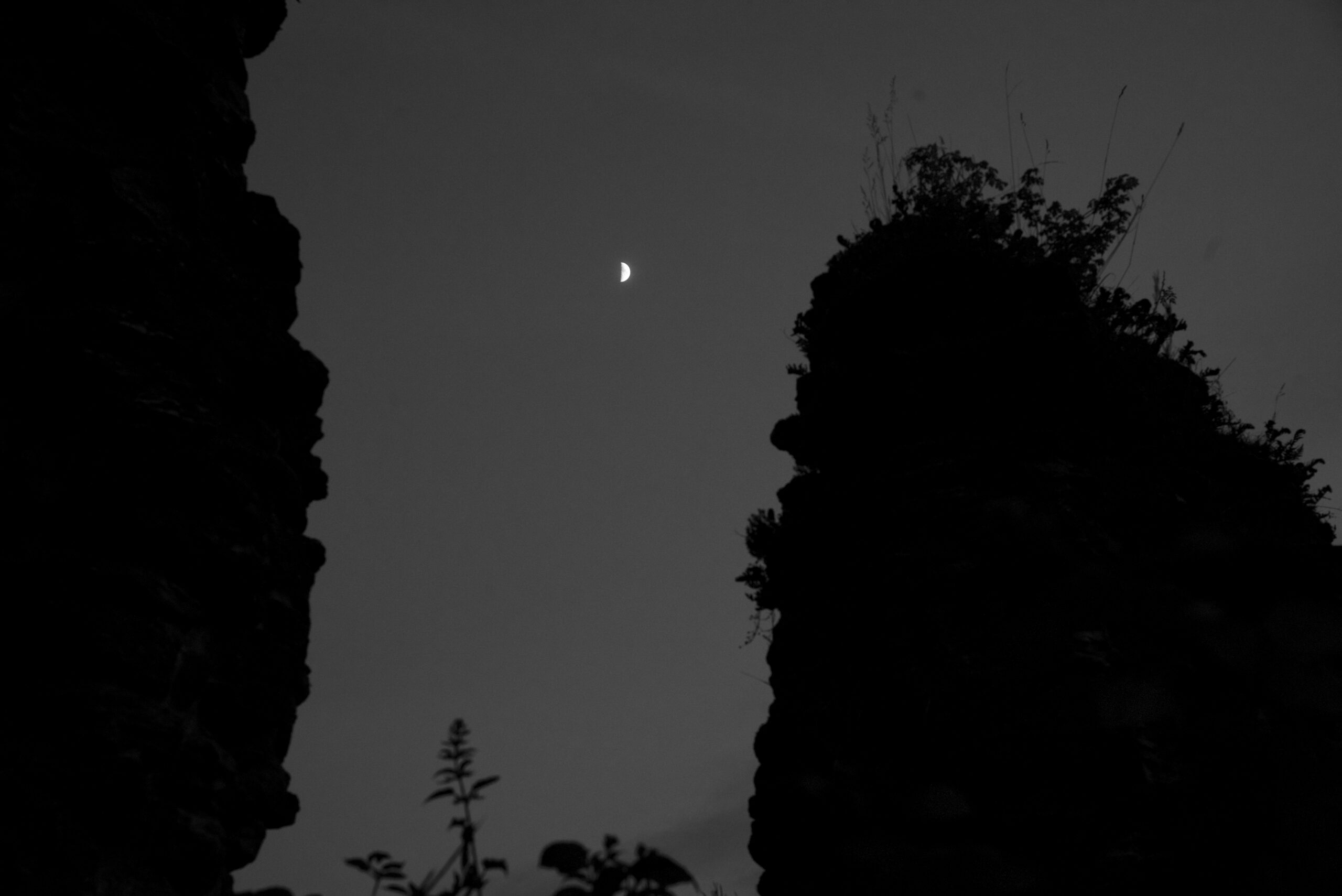
Some castle ruins are truly spectacular. They’re grand and spooky, jutting out of the landscape like leering skulls. They take the high ground, you take the low. They’re one of the great subjects of the romantic imagination. Moons rise over them otherworldly, you can hear hooves striking stone, swords being drawn. Wales is full of these castles, so many that after visiting, say ten, you start thinking that they’re perhaps not really there, that you didn’t visit at all, you just imagined them, walked their ramparts in a dream. Or, if you’re more sceptically minded, that there is some well equipped props department, owned by the Welsh tourism authority, which is employed to set up dramatic scenes in spectacular places for the summer season, just to keep the tourists spending money (I’m sure this is true).
However, some castles are so unspectacular they’re almost not there. You find little tangles of brambles out of which pokes a low pile of bricks which was apparently a gatehouse once, or a line of stones barely mortared together, a sheep scratching itself on one, which was the perimeter wall of a vast and ancient edifice.
Wigmore Castle is somewhere in between. I’d actually never heard of the place until a few Saturdays ago when I was driving along the border, visiting places in Herefordshire I’d never been to, having been told off by a friend for spending too much time on the Welsh side. Guilty, I have, because the Welsh side has the mountains, the mist and the mystery.
I passed through the village, and saw the sign on the road, pointing to a ruin which didn’t seem to exist, there were only trees and pasture. Mysterious. I did a U-turn, followed the sign, and, just as I thought, the place didn’t exist, the sign pointing in the direction of a 1970s village hall, where I parked. Ah, but this was just the car park for the castle. There was another sign on the opposite side of the road pointing to the actual castle. I scanned the woods and hills, still no castle. I followed the sign up a narrow path through knee deep wildflowers and hazel trees to a churchyard filled with leaning graves. I visited the church, which wasn’t that interesting, and I was about to give up when I spotted yet another sign pointing along a narrow lane. Minutes later I reached the ruins of one of the grandest and, for a short period, most important places in the medieval world.
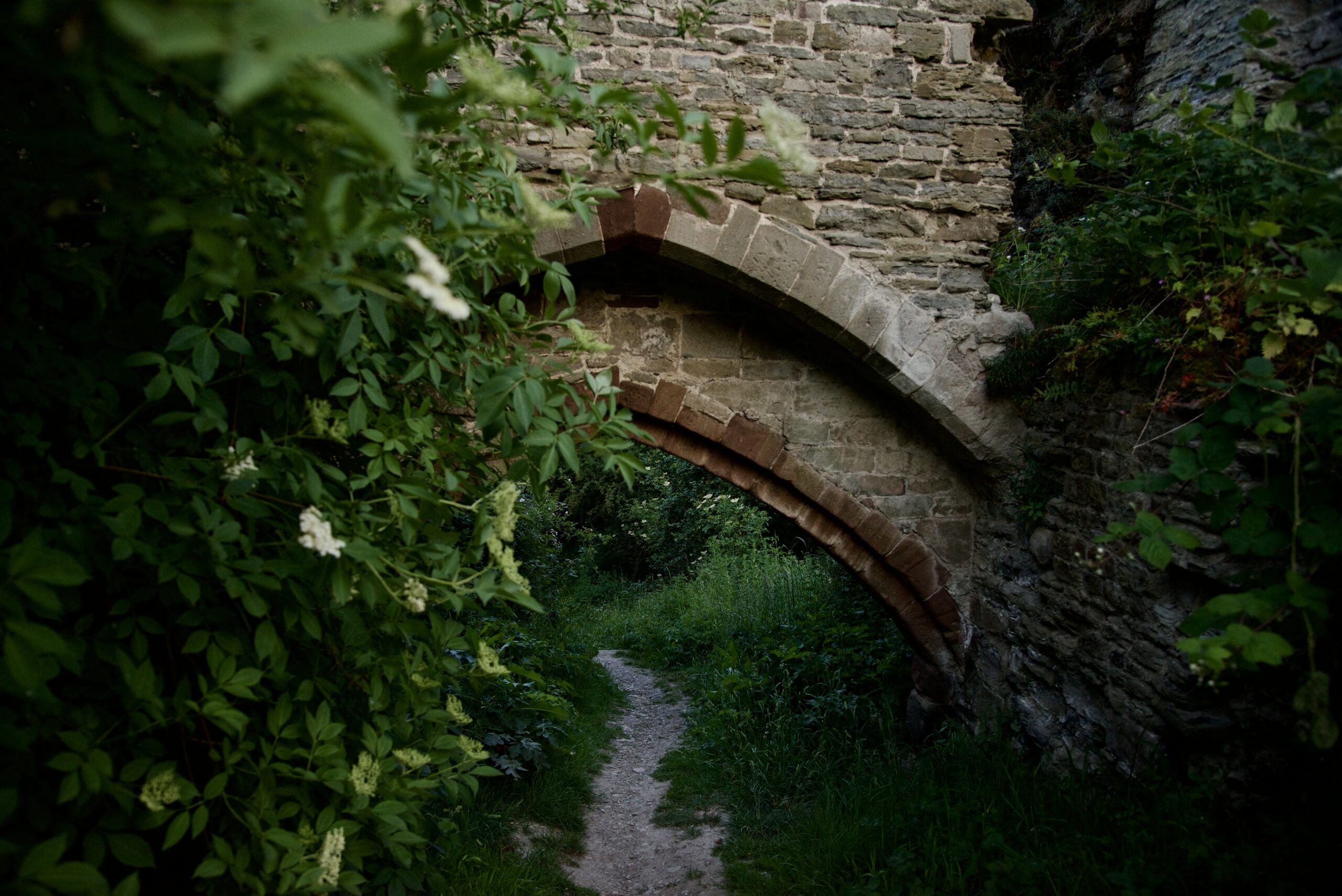
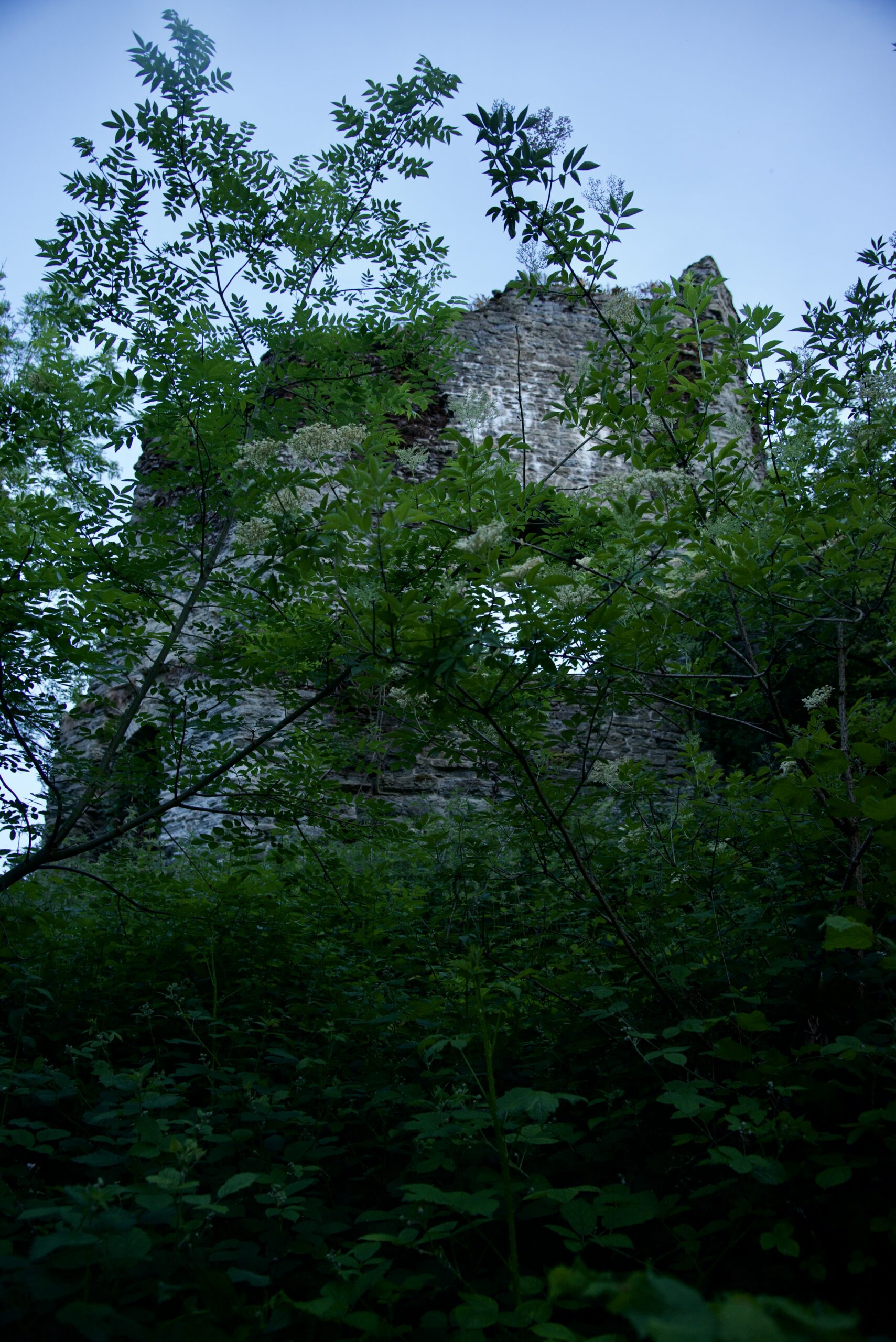
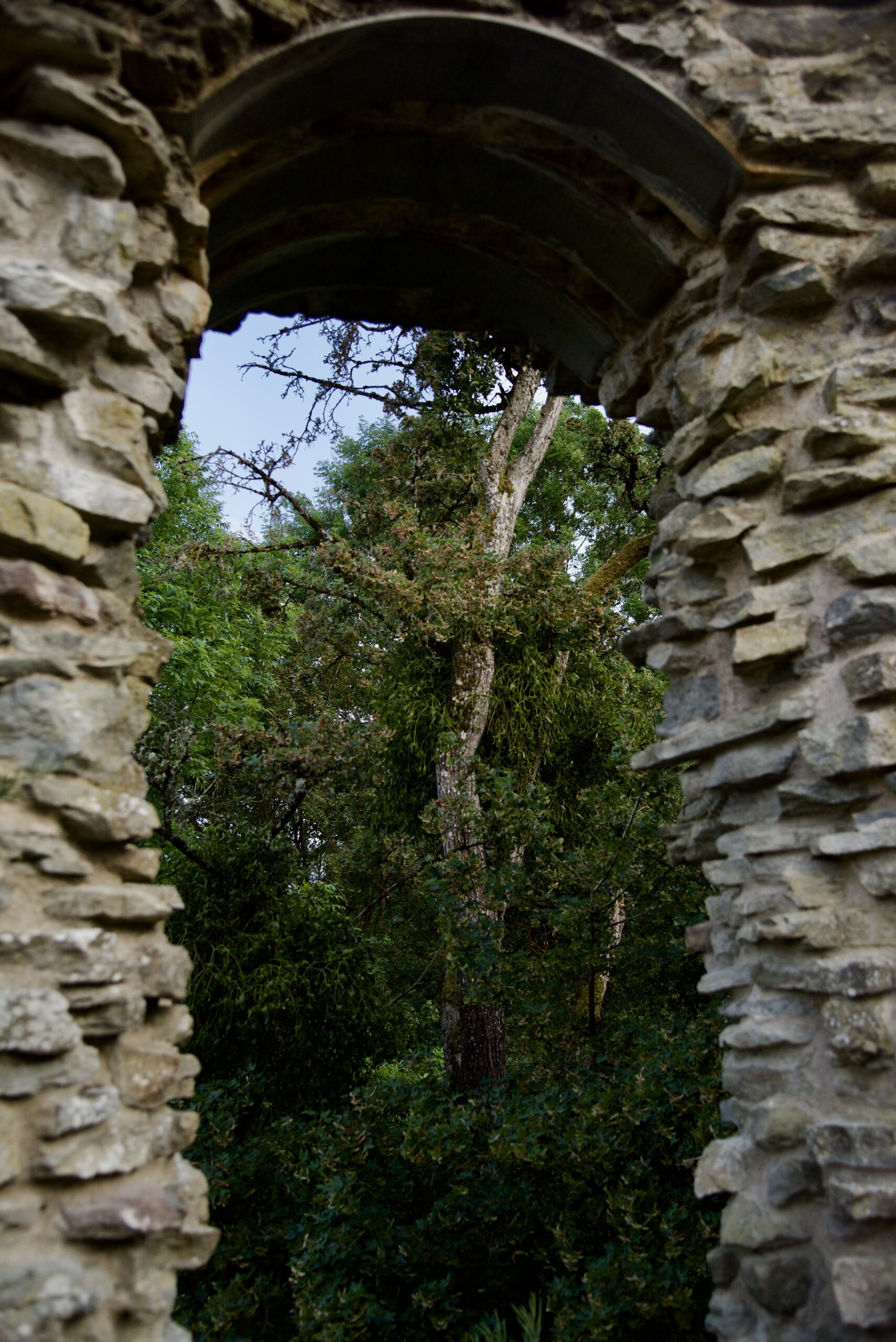
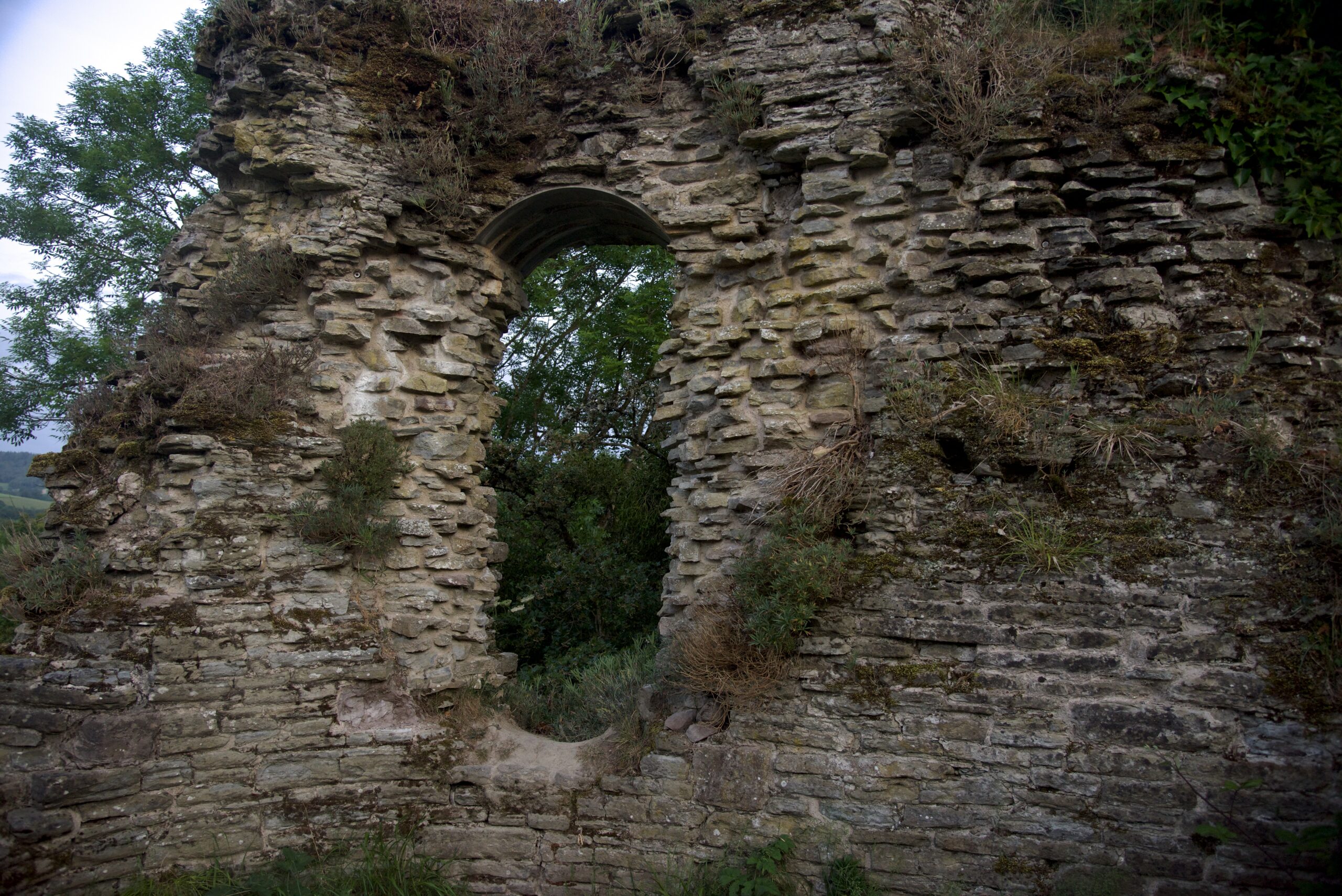
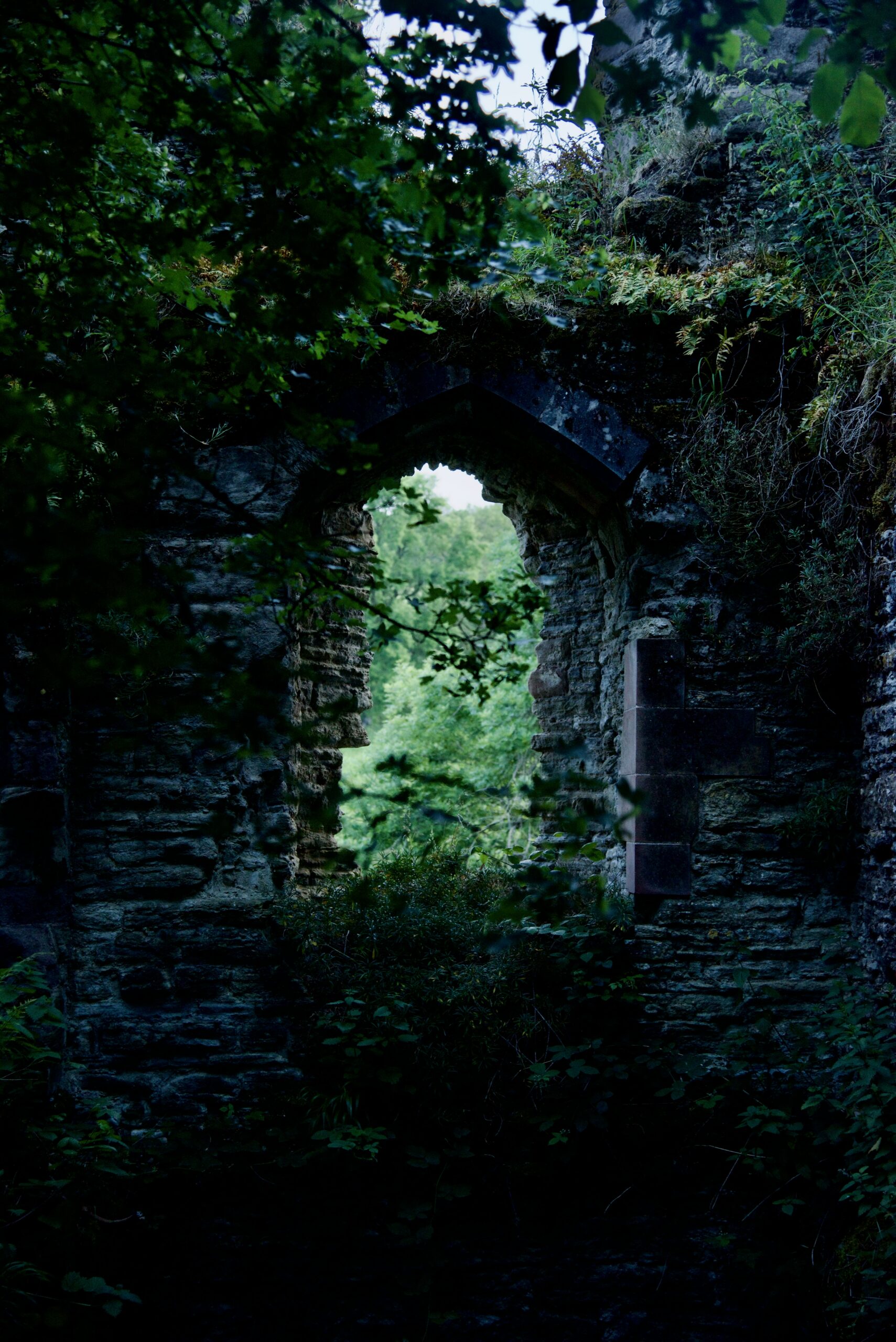
Stones remember the way we remember: fragments above ground, vast subterranean remains. Ninety percent of Wigmore Castle is buried, recolonised by the wild. It’s a dark green place filled with birds and butterflies. It rises on steep ground, topped by a huge motte built shortly after the Norman Invasion. Out of bushes of dog rose rise the remains of the arched gatehouse with fragile steps leading up to it. Beyond is the high fang of the keep surrounded by the collapsed walls of the inner bailey. You can’t picture what the original structure looked like, it’s too tangled. You wander through the brush and happen on weathered structures which resemble forest chapels or ancient hermitages. You half expect the Green Knight to be sitting there, preparing for combat.
The castle was once home to Roger Mortimer, 1st Earl of March, who, though born a second son and destined for a monastic life, became one of the most powerful men in Europe. His older brother died young and he inherited the huge family land holdings. In his teens he married the heiress Joan de Geneville who was a member of the royal House of Lusignan in France, a family which would become rulers of Jerusalem, Cyprus and Armenia.
Mortimer later became the lover of Isabella, Queen to Edward the 2nd. Their affair resulted in his imprisonment in the Tower of London, but he escaped, fled to France, raised a rebel army, and returned to overthrow Edward. They handed the throne to Edward the 3rd, who was too young to rule. For two years Mortimer and Isabella governed England until the young king eventually had the earl executed at Tyburn for treason. His body was left hanging for days as a lesson to the London populace who had aided the rebellion, and he was eventually buried at Wigmore Abbey, two miles from his castle (now also a ruin in almost total collapse).
Mortimer’s holdings were huge. He controlled most of the Welsh Marches and large parts of Wales, and of Ireland where he was made Lord Lieutenant. For a time Wigmore, a place in the middle of nowhere, was a centre of power with fingers reaching across the old world. It was a grand castle with 2 metre thick curtain walls and huge guard towers, containing luxurious apartments, surrounded by farms, deer parks, fish ponds, rabbit warrens and dovecotes. Lavish tournaments were held there. Kings and queens came and went. After Mortimer died his heirs maintained the grandeur of the place for two centuries until the English Civil War when it was partially demolished. Its slow crumbling and rewilding began.
In the 1990s a refurbishment of sorts was carried out, not to restore the structure, but to encourage biodiversity. Thirty years later the place is effectively a nature reserve, an island for the wild in the extensively and intensively farmed north west of Herefordshire.
I was there in the golden hour, under a clear sky. The wind was up, the tangled growth thrashing and leaning. I was hoping to see bats – you have to in a spooky place like that.
I remember the first time I encountered bats. We were on a family holiday in Devon, which my parents hated. Usually we stayed on a caravan park on the edge of a busy Cornish seaside town, but this year they’d left it late, couldn’t get a space and were forced to take a late deal, staying instead on a farm in the deep country around Barnstaple. A dark lane led through a tunnel of oaks to the farmhouse. One evening we went for a walk along this lane. I remember the clouds of insects which were common back then, the smell of cattle and warm hay. It was alien to a towny like me, and deeply mysterious. As the sun set shadowy shapes began to swoop over our heads, hundreds of them, sometimes so close they passed you almost with a kiss. I remember nothing else about that holiday, only that fragment of time with the bats, which both terrified and enchanted me (terror and enchantment have an on-off relationship). I’ve loved them ever since.
If I’d visited Wigmore Castle, at this time of year, when I was a boy I’m sure I’d have heard Rudyard Kipling’s “beat of a horse’s feet”:
Yet, if you enter the woods
Of a summer evening late,
When the night-air cools on the trout-ringed pools
Where the otter whistles his mate,
(They fear not men in the woods,
Because they see so few.)
You will hear the beat of a horse’s feet,
And the swish of a skirt in the dew,
Steadily cantering through
The misty solitudes,
As though they perfectly knew
The old lost road through the woods.
But there is no road through the woods.
(You can read the full poem – The Way through the Woods – here)