I’m sitting at my desk watching the wind tussle a tangle of ivy which is attached to the wall of the ancient coaching inn opposite our house. Leaves shivering, seed heads bobbing like fishing floats, the last seeds still waiting to be picked by the fat pigeon which sometimes arrives, when all its other foragings have failed. Beyond are the stone and timber houses of Kington, roofs at every angle, a precarity of chimneys, tv aerials listening-in to the world’s worst conversations. Every window is dark. People are shuffling down the high street, shopping for groceries. They carry cardboard coffee cups, cigarettes and vapes, sagging plastic bags. Some stop to chat, talking about the arctic wind, the snow which might arrive later. The butcher serves his queue of customers who shuffle towards him across a sawdust floor. His white apron is a little bloody, the chopping block behind him still dripping pink from mounds of diced beef, perfectly arranged pyramids of gore. Hairdressers snip, heads tilted in utter concentration. The man in the carpet shop, the most deserted of stores, stares out at the street, tragically lonesome, as a knot of traffic follows a slow-moving bus and the pedestrians on the too-narrow pavements step back nervously. It’s a narrow place. The buildings are too high and they lean over the pavements like reapers. Some say this place has been left behind, that it needs an injection of energy. They’re thinking commerce I suppose.
On my windowsill, crowding out the view across the town is a collection of objects I’ve gathered over the decades. Probably once a month I rearrange them, make little changes. There’s a clay figure of an owl which we bought home from our honeymoon in Africa, a silver teapot my wife inherited from her grandmother, paint brushes, dried up pens, a picture frame containing a skeleton lotus leaf that someone sent to me from India. There are many interesting stones (our house is full of them), a few fossils. In the centre of the sill is a red begonia plant that I bought when we moved here. It has heart shaped copper-crimson leaves with stars in their centres, tiny hairs covering the stems. Miraculously, given my gift for houseplant neglect, it’s just come into flower. The bowed stalks are tipped with slender branches, each with a pair of miniature leaflets. The flowers are translucent and frosty with stamens the colour of buttercups. Every day a flower drops, leaving behind a question mark. Was that it? Where are we going now? Things that change slowly, or quickly. Things that change endlessly.
And things seem to be changing rapidly now – our society, the world, the weather. There’s a threat in the air which hasn’t been present in my lifetime. You can sense it in the town which has resisted transformation longer than most, content with its delapidation, still connected, somehow, to the ground around it. But you can still hear the voices in the distant centres of power. Break it all, they’re saying, scatter it, throw it away.
_
There’s an old woman who I sometimes see in town. She’s bent almost at a right angle and walks tortoise slow, one step barely pushing in front of the other. She leans on every wall and windowsill to take a break from the exertion of the short walk to the high street from her house. I’ve often asked her if she needs help. She always refuses politely. “There are other people here in much more advanced stages of decrepitude”, she says. I haven’t seen her for months. She may be housebound, or gone from this world.
My calves are aching. Every morning this week I’ve walked up Hergest Ridge with the dogs, touched the trig point and walked back. It’s not mountain steep but it is steep in places. It’s taken me three years to become familiar with the ridge. In reality I barely know the place at all. I go there for the quiet, for the long view, to stop the spinning world for an hour or two. I’ve still not found all the tracks through the gorse and bracken and I’ve missed so many of those miraculous slants of light, swirls of fog, sunrises and sunsets, births of foals and lambs, broods of skylarks and wheatears. The shy unfurling of harebells.
_
There are thirtyish golden plovers on the ridge at the moment. They’re spooky shy.
I don’t notice them until I see little scurrying shapes on the ground, moving away from me, a little further, further still. If I spot them early I change direction, do not disturb. But I have a spaniel and she has a mission to cover every inch of this world – to seek and find lost tennis balls. Ah the golden plovers! Swerving scatterlings. Occasionally there are hundreds of them, flying in echelons which suddenly break, shift back, fold in. It’s so quiet on the ridge you can hear their wings from a distance, their faint peeps as they discuss things – the mountain views, last night’s dreams, tomorrow’s plans. Does any bird transform as much? There’s nothing golden about golden plovers in the winter. In late March though you start to see them changing, dark stripes appearing, their backs starting to shimmer. Just before the transformation is complete though, they’re gone, off to the green mountains and soaked moors, to hide their shining garments and fragile young. I’ve yet to see one in its full finery and I’m happy with that. Glimpses are enough.
_
Have we fallen out of love with the world? I think not, but perhaps it’s fallen out of sight. I wonder how many people, walking across the ridge, actually notice the birds. Hill walkers are often so goal-focused: elevation gain, steps taken, shots taken, viewpoints visited. I’ll admit that I’ve stood beneath the plovers with my arm out, watching my phone screen as I try to capture the sight on video. This is a futile task – that tiny screen, those distant birds. When you play it back the world of the plovers has vanished, replaced by pixels, wind scuffed sound, flat light, the hills all the wrong colours. What you record on video is just the reduction of things.
It’s near the ridge, perhaps on it, where the ice sheet reached its southern extent twenty thousand years ago. I sometimes stand on the summit, look straight up and imagine a vast blue wall above me. It undulates jaggedly. There are promontories and peninsulas topped with ice castles, smooth-walled caverns, shining ravines, translucent valleys. Ice rivers terminate in huge waterfalls which smooth the edges of fractured bergs. Looking south there’s not a single tree in sight. An orchestra of ice rumbles, screeches and moans. The wind hurls sharp crystals. I see a dark patch just behind the skin of the ice. Slowly it pushes through, an anvil of rock which the glacier releases. It falls, spins to the ground, lands, rolls and comes to a stop at my feet. It’s still here, only slightly eroded over the millennia. We call it The Whetstone. I sometimes sit on its top. I ask it how many golden plovers it’s seen since it travelled here. Oh, millions, it replies, though not too many around now.
_
It’s late afternoon and the light has dipped. The pigeon just arrived to feed on those last ivy seeds. It landed precariously, sinking into the mound of leaves until it almost disappeared. Then it battered its wings, twisted it’s bulbous torso, tried to pluck the seed-head off, failed and fled. It’ll have to try again when it’s hungrier, or just give up on the idea. A blackbird came shortly afterwards, landed with a little more elegance and poked it’s head into the space beneath the leaves. The nesting place.
_
The old farmer who sells her chickens each week at the market has decided that this will be her last week. I’ve only recently started buying from her and I like the short conversations we have. She tells me about the deer in her woods, how her husband hunts them, how they pluck chickens and pheasants, skin and prepare venison. It’s hard work she says, she’s up before six every day. When I last bought a bird from her I didn’t know she’d be gone soon. It’s probably not worth her while, all that work just to sell from a tiny table when down the road the supermarket ships poultry in from vast barns and trades them for half her price. The street across from our house is called Duke Street, a gentrification a neighbour told me. It used to be Duck Street. The farmers came down from the hills to sell their produce each week, the whole town filled with sheep, cattle, poultry. She was the last of them.
_
Years ago I visited the Athabasca Glacier, which is one of several toes of the Columbia Icefield, the largest in North America. It formed in the early interglacial period, before homosapiens evolved. It advanced in the last ice age, advanced further in the little ice age and has been in retreat for almost two centuries, which is the same time that Europeans have known about it. It loses five metres of ice from it’s surface every year and by the end of the century it will be gone. The glacier gets more visitors than any other on the continent. A visitor centre arranges for tourists to travel onto the icefield in giant trucks. The centre has multiple restaurants and a Starbucks. You can sit in urban-familiar surroundings, sheltered from the cold, staring out at the wild and unfamiliar blue land. Search for the glacier on Instagram and you’ll find reems of images: long lines of snowtrucks crossing the ice, people twirling flags, couples kissing, underdressed women leaping from rock to rock, young men in trendy outdoor gear staring down into crevasses. Looking at those images you might think that you’ve discovered another place to add to the bucketlist, and you might push to the back of your mind that including it accelerates its demise. Your grandchildren may visit that place some time in the future, to wander through sedgy moors scattered with eratic boulders, a place a little like Hergest Ridge. Rapid transformations. Gathering shadows.
_
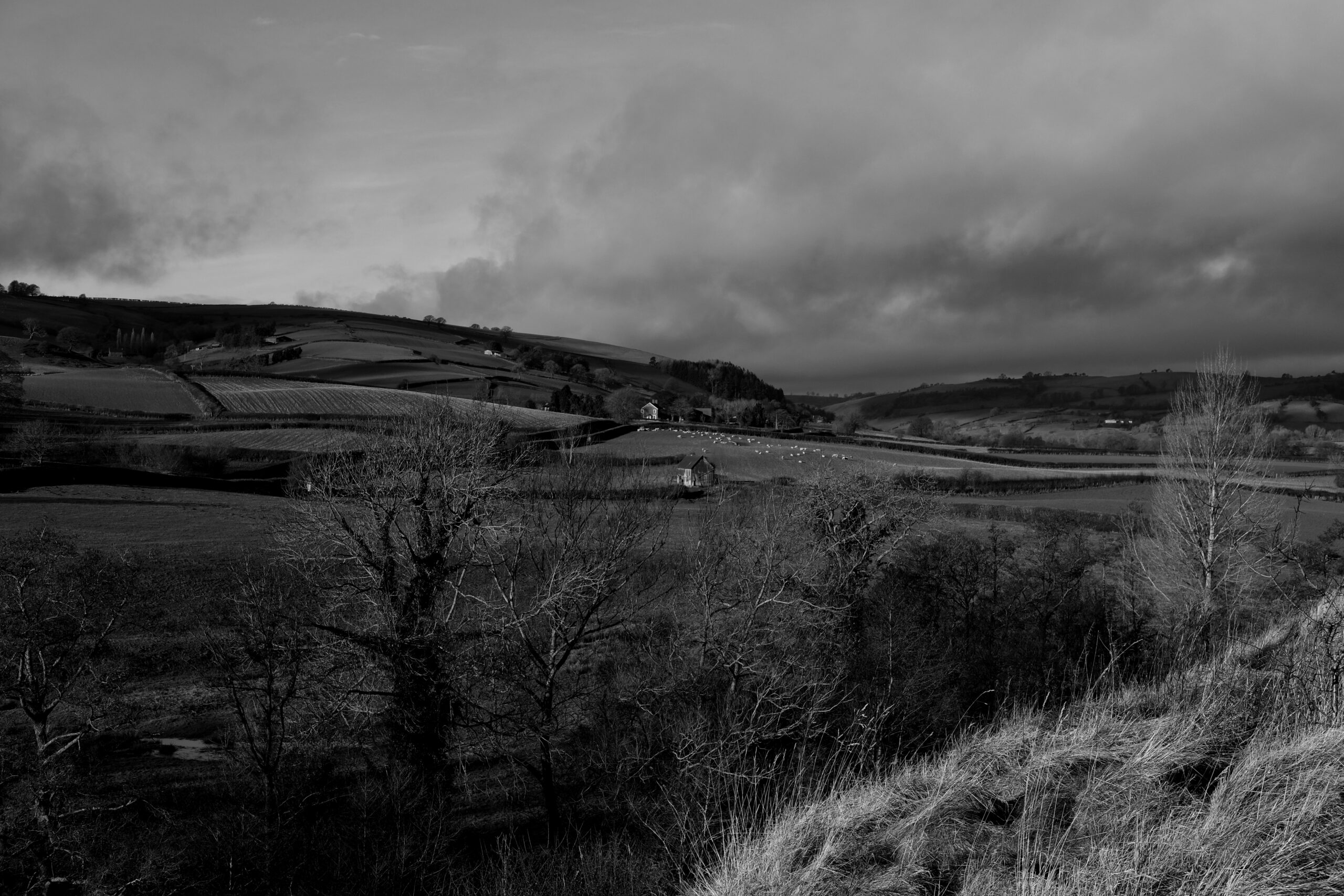
You can’t see the ridge from our house. You wouldn’t know it was there and for most people it isn’t. From the south it’s just one of the grassy rises that undulate along the border, not especially prominent. The road which skirts its northern edge is never busy, heading towards the underpopulated hills of Radnorshire, away from the black and white Herefordshire villages and market towns. That road has spectacular views of the ridge. It seems much higher than its thirteen hundred feet, a giant wall. In certain lights on winter days, a blue wall. I drive along the road most days. I often look for the ridge in the distance, but strangely it’s not there. Hanter Hill, its little, conical, rocky sister appears on the horizon and then quickly disappears, obscured by acres of forestry. And then it reappears, but strangely in another place. I’m pretty good at orientating myself, I rarely get lost, but every time I look at it that second time I’m confused. The road is arrow straight, Hanter Hill is directly ahead, but then it’s to my right. I pass over a rise and there it is again, in front of me, in the shadow of the ridge. Places shift around it seems, transforming like icefields in our imaginations.
Time flows slowly beneath a ridge, and only its surface exists in the present, which, of course, doesn’t exist. Everything we see has just disappeared, everything we will see is not there yet. We stitch the seam between the two with our imaginations, which at the moment are shrinking. You might call it our cultural topography. Perhaps it’s natural shrinkage, like the retreat of glaciers. Or perhaps its being caused by those who are so determined to grasp the future, to harness and control it. They’re leaving us in their wakes and their wakes are literally flattening mountains.
My elderly neighbour is born and bred Kington. She moved into her house when there was no electricity and running water. Our garage was the shared toilet and there was a washroom up the alley between the burgage plots. That was in the 1980s. Most of the people I know hadn’t lived like that since the 40s, but things change slowly here. She brought her kids up in the house, and now she looks after her great grandchildren there while the house slowly crumbles. There are ferns growing out of the chimney bricks and most of the roof slates have slid. If she’s ever been up on the ridge she hasn’t told me so. You can spend a whole life never seeing the hills.
Here and there on the ridge are the remains of old farm machinery: horse pulled ploughs, seed drills, rakes, harrows. They’re rusting away far slower than ice melt and may outlast the Columbia Icefield. Our discarded machines will outlive something that existed before we evolved. To the north of the ridge a line of small hills is all that’s left of a volcanic upwelling, the oldest geology in Wales, consisting of granite and gabbro rocks which were strontium dated at 700 million years. A parallel hill is called Dolyhir, once a wooded dome like the others. You can just make out its original shape if you stand in the fields below Hanter Hill. It would have been a gentle upwelling, a bubble in the strata. But it’s cut up now, just a broken tooth with the gaping mouth of a giant quarry beneath. A hill almost gone, vanishing faster than a rusting plough.
_
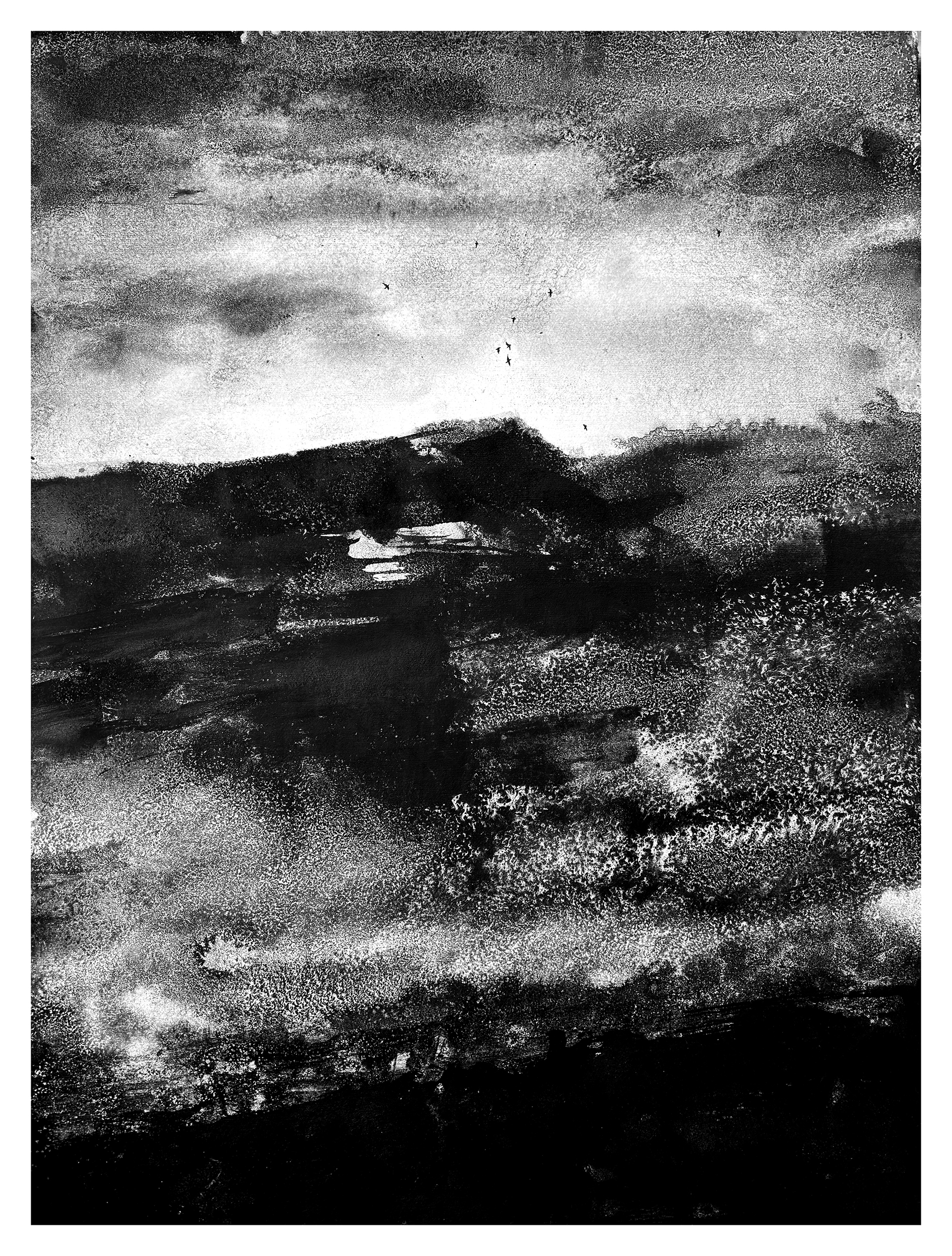
This week I’ve finished a painting of the ridge and its surrounding hills. I don’t usually paint landscapes. But I wanted to get a sense of the flow of my square mile. My process with ink and salt allows that. You can’t get trapped in the details, accuracy isn’t the point. You flood the paper with water, add ink with a thick brush and the whole thing starts to move. The ink spreads fast, runs into the slightest downslope or undulation, moves like ice melt. Adding salt allows you to slow this movement, to fix it in place. Then the salt begins to absorb the pigment and the image loses its fluidity, takes on the texture of stone. It’s a little like the way landscapes are made.
The scene I’ve painted is from the top of Bradnor Hill, looking out across the valley to Stanner Rocks, Hanter Hill and the ridge, which is probably one of the most beautiful views in Britain. From up there you can see over the ridge to the Black Mountains and Brecon Beacons. The sun sets directly in front of you, usually through gaps in coloured clouds which push in on the westerlies. Fans and spears of light, emerald pools shifting across summits, shadows deepening in the folds, rainbows, fogbows. The ridge changes and changes again. Sometimes it disappears. Looking out at that, if you didn’t know that the land is alive, well you do now.
_
You can’t see Hergest Court from the view point on Bradnor Hill, it sits behind the ridge, surrounded by oak woods, a secretive place that time seems to slip around, not through. The Red Book of Hergest was kept there once, that famous compendium of ancient Welsh poetry and myth. It contained one of only two original complete transcriptions of the Mabinogion, written 600 years ago, but the stories are far older. Hergest Court was built by the much storied Vaughan family, who, so local legend says, were shapechangers. Black Vaughan could appear as a bull, a giant hound, a plague of stinging flies. The Mabinogion is filled with shapechangers: a woman made of flowers turns into an owl; two lords swap skins to vanquish an enemy; a prince changes into a stag, a sow, a wolf. Human transformation, into and back from the wild, was part of our cultural topography centuries ago. It’s still here it seems – that giant hound is often seen.
A century ago our house was once owned by a Vaughan, when the horse drawn ploughs were still being used on the farms adjoining the ridge, when the Athabasca glacier was still growing. If I believed in such things, and I sometimes do, I could make believe that the black hound once roamed this house. Perhaps it slept on the floor, here, next to my desk, which is up on the second floor and looks out across the town, but also at a group of trees which each spring become clotted with rooks’ nests.
Rooks nest early in the year, often before the last snowfall, which will probably happen today. Over the winter, the owners of some of those trees had them cut down, perhaps to stop the birds from nesting there. But birds are used to changes and they’ve just shuffled over to the trees in the adjoining garden, where they now sit calling endlessly and tunelessly. They wake me up in the night and I forgive them because I’ll love them forever.
_
Apart from my family, birds are the most important things in my life now – birds and hills. The birds seem to stitch the world together for me, a form of wound tending. Above the nesting rooks a pair of red kites often circle hopefully, waiting for opportunities. The rooks see them off several times each day and the kites head back to the ridge for a while, or further afield along the border. When I moved to this area kites were a rarity. Their numbers and range have slowly increased, you could say at the pace of glacier melt. Or of rust. In that time the town has undergone many transformations. People have moved out or moved in; old people, and some far too young, have passed away; shops have emptied and refilled, houses have collapsed and been rebuilt or built over; the ancient burgage walls have sprouted ferns and wildflowers in their crumbling mortar. The streams that flow around the town have expanded, shrunk, changed course, changed composition. Besides the changes the birds have kept bringing news from the hills.