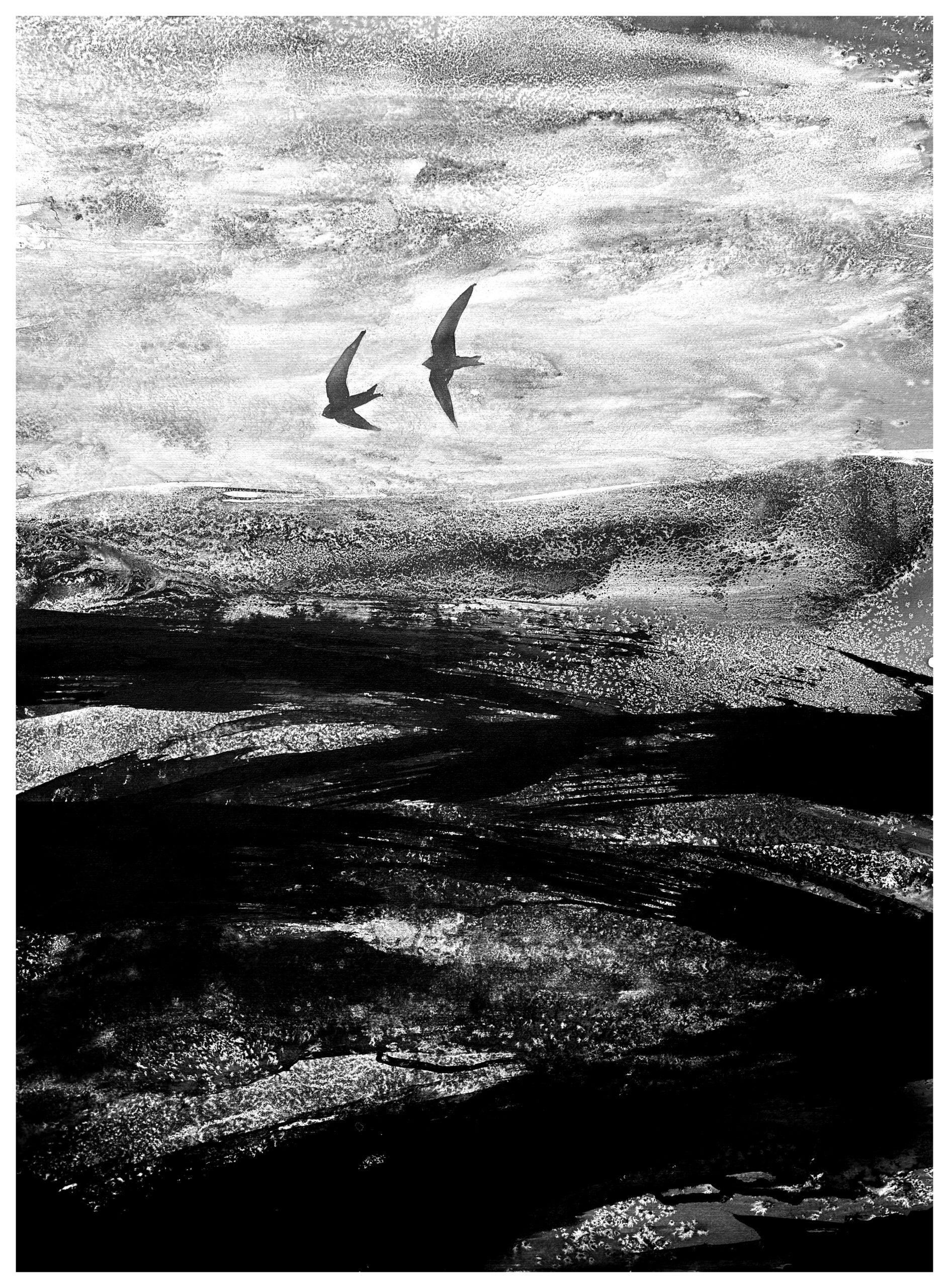
I’ve lived for the past two decades in the Welsh Marches, where the high hills of Wales descend to the Herefordshire plain. It’s a place of big skies and shifting light.
Those big skies are rarely empty. Red kites and buzzards circle over them as if they’ve been sent by the gods to keep an eye on us. Jackdaws rattle in the trees and each evening they swing above the roof of my cottage like circus acrobats.
We have six seasons in the borderland: spring, summer, autumn and three winters. If, like me, you live in the shadow of a big hill, in at least two of those winters you may never see the sun. It’s not as bad as it sounds. Our skies are rarely flat. They swirl and transform, the ghost of a sun penetrates the clouds and slides along the valleys. The woods glow then go back into hiding.
The big hill in question is Hergest Ridge. All winter a flock of golden plovers stay there, some years only 20 or 30, other years perhaps 100. If you’ve ever watched a flock of golden plovers you’ll know that you’re blessed. Sometimes you’ll hear a distant high-pitched call and look up to see an echelon so high that it’s barely visible. The birds cross the ridge then turn in a wide circle. Occasionally the echelon explodes into shrapnel. The flock plummets to earth, slows, lands, and instantly disappears. It’s hard to spot a flock of plovers on the ground, so well camouflaged are they against the bracken and sedge. Often I’ve walked right into the middle of them and only noticed when the birds closest to me began to scurry away.
They stop, then scurry again. Then, if I’m lucky, they rise.
My place, as all places are, is a place of arrivals and departures. Spring ushers in the chiff chaffs, blackcaps, cuckoos, swallows and swifts. In the autumn they vanish to be replaced by redwings, fieldfares, goldcrests. The local lakes fill with cacophonous, gangster geese and anxiety-ridden ducks.
I welcome them all, but curlews get special attention. It was the curlews that opened me up to the world of birds, the singing sky. But it wasn’t until I was almost 40 years old that I discovered them.
It was an unpromising first encounter. I made my way onto the upland common above the village where we’d just moved. It was early April, meaning winter number three in the uplands, everything sodden and bleached. Dusk was falling, mist covered the hill and I could only see 50 feet in front of me. A silence I’d not encountered before was punctuated by the lonesome howl of a farm dog. If you’ve ever seen the film “An American Werewolf in London”, picture the scene where the two friends are crossing an empty moor at moonrise, mist gathering and the werewolf approaching. I had an overwhelming urge to turn, sprint to my car, put my house up for sale and move back to Sussex where things seemed a little less threatening. I’ll admit I’m timid.
But the mist lifted and a spear of sunlight made the hill luminous. A bird was passing over, flying low to the ground, approaching a small pool which now glowed white as if filled with milk. A bird I didn’t recognise, with a long, down-curved beak. And then it began to throw out its long trailing call. I teared up the way you do when you’re smitten. Every year since I’ve waited for them to arrive each spring like a jilted lover hoping for one last encounter with the beloved.
That last sentence is not intended to contain a simile. It’s true, I am the jilted lover.
The curlews in my area are in decline, their numbers have plummeted in my lifetime. There may come a spring soon when they no longer breed in the Welsh uplands. There’s hope though, curlews have become a priority conservation species. We’re watching over them. There’s a possibility, if the good work continues, that the skies around my home will sing for my grandchildren the way they did during the lives of my grandparents. In late February this year I watched a flock of 70 curlews flying out over the edge of Llangors Lake. Every time I’ve visited the hills this spring I’ve either seen or heard one.
Birds always seem a little distant and skittish to me. I’ve never been able to persuade one to pose for a portrait for instance. Unless you have the field skills of a bushman, or a camera lens so long you need to have it helicoptered in, a close encounter is rarely possible. This is particularly true of curlews. Indeed there is a Welsh legend which states the reason for this. Saint Bueno, who often walked across the Menai Strait going home from a sermon, dropped his book of prayers into the sea and watched with horror as it sank. When he reached land he found a curlew sitting on the book, protecting it for him. As a reward he gave the bird the gift of hiddenness. This gift is still strongly possessed by its descendants. Curlews are usually gone before they’re there, heading off into the distance, leaving behind them a wake of song. Their nests are almost impossible to find.
When I was a boy at school I retained little in class and initially my teachers thought I was hard of hearing. Later they realised that staring out of windows was my passion, so they put me at the front of the class, away from the view. Things didn’t improve. As a teenager I was considered disruptive and I advanced to the storeroom and eventually the book cupboard. Perhaps this is why I need to spend so much time outdoors now. Perhaps it’s not too late to sue. The reality was that as a child all I wanted to do was watch the sky, make things and run fast. Now, as an ageing adult, all I want to do is watch the sky, make things and walk slowly.
Walking is the most important part of my practice as an artist. I’m sure I’ve walked thousands of miles over the hills of the borderland and the western edges of Wales. It’s a compulsion. A day without walking is a lost day. I need to feel the air, to be in my animal skin. Images start to form when I walk, not from the inside, but from the outside. Places provide them and the birds provide most.
We need to give our time, the greatest gift we can give, to the land around us. It’s something we’ve done for almost the whole of our evolution. I believe we miss it badly.
An artist’s purpose is not, or so my theory goes, to teach us how to see, but to help us remember how to feel. It’s getting more difficult to feel a connection to the land the way our ancestors did — to the real things of earth and feather, leaf and bone. Screens beckon us constantly. There’s so much noise. The virtual takes up more and more of our days. But I believe we can find connection again and it comes through attention. The more attention we give, the more we can attend to the community of life. Artists are devotees of attention. Mine is directed towards wild places.
Years ago I spent time in Kenya, visiting places like the Maasai Mara, places that, at the time, still teemed with life. I camped in a flimsy two pole tent for almost a year. Given my lack of bush skills and my aforementioned timidity this occasionally made for difficult moments. Like the time I camped on the track to the waterhole for a herd of 200 elephants and woke in the morning to find their giant lily pad footprints in the sand around my tent. Fortunately for me elephants have dexterity with guy ropes. Even more fortunately I’m a sound sleeper.
There’s a Maasai proverb that I still have pinned to the wall of my studio. It says:
“If the lion has no praise singer the tale of the hunt will always be told by the hunter.”
It seems to me that the wild needs praise singers more than ever now.
Lions and elephants need praise singers.
Jackdaws need praise singers.
Golden plovers need praise singers.
Curlews need praise singers.
The hills need praise singers.
Artists can’t save the world, but we can help people fall back in love with it. And what we love we’ll fight to save.